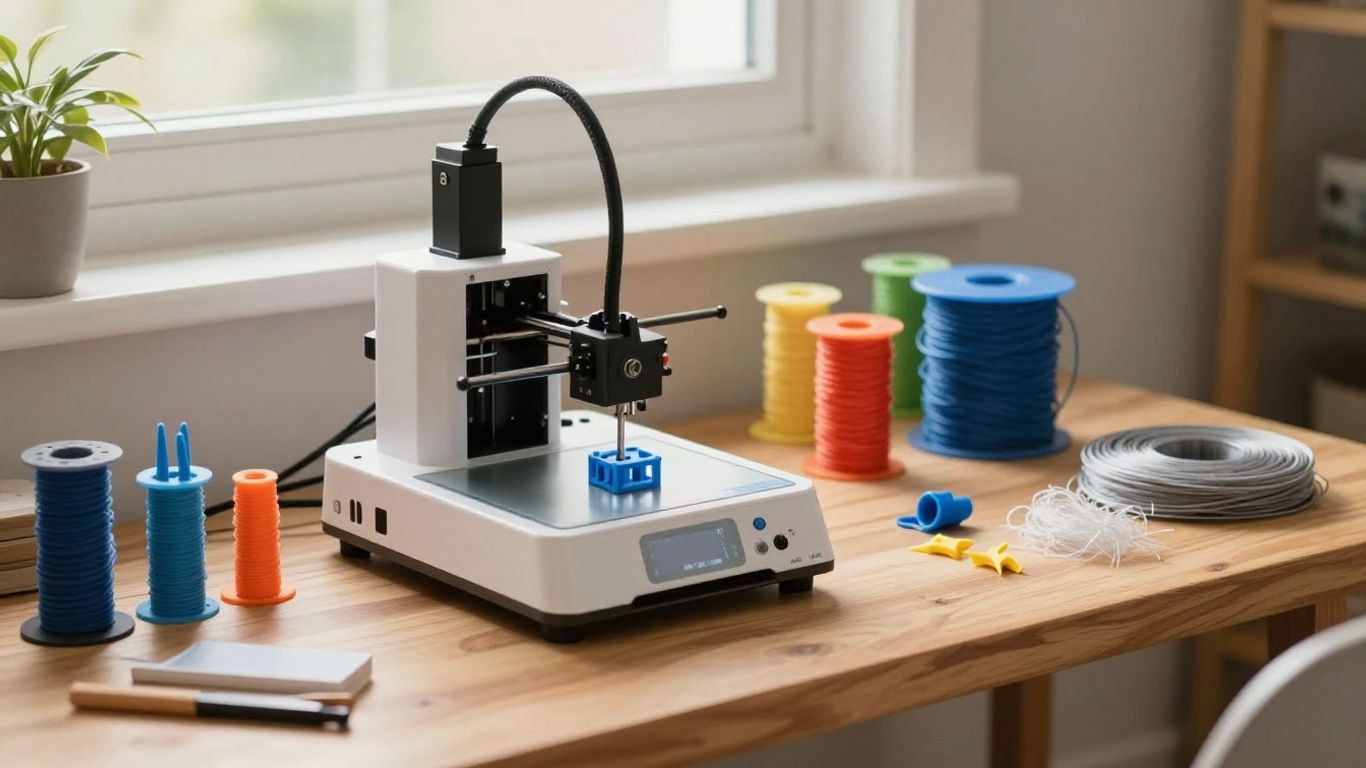
What 3D printer filament is and why it matters
Filament is the plastic thread your FDM or FFF printer melts and places in thin layers. The material you choose affects how easy the print is, how it looks, and how well it survives daily use. Once you have a few filament types explained in plain English, choosing becomes much less mysterious.
How filament becomes a printed object
Your printer feeds filament through a heated nozzle, where it softens before being laid down along a programmed path. Each new layer bonds to the one beneath it, gradually building the object from the bed upwards. When the plastic cools, it becomes rigid enough to handle, although the final result still depends on layer bonding, print direction, and the material itself.
A small household bracket, for example, may look solid but is really a stack of carefully placed lines. That is why a part can be strong in one direction and weaker in another. The slicer controls this pattern, while the filament determines how those lines behave once they cool.
The role of filament diameter and tolerance
Most desktop printers use a narrow, consistent filament diameter, commonly around 1.75 mm, but you should follow your printer’s specifications rather than assume. If the diameter varies too much, the extruder may push out too much or too little plastic. That can create gaps, rough surfaces, weak layers, or inconsistent dimensions.
A reliable spool should unwind smoothly and remain reasonably round. Check the product information for its stated tolerance, and avoid letting the filament cross over itself on the spool. A snag can interrupt extrusion just as surely as a poor-quality material can.
Comparing strength, flexibility, heat resistance, and durability
“Strong” is not one single property. A filament can resist snapping but soften in a warm room, or flex repeatedly while carrying very little load. For a practical part, think about the forces it will face: bending, impact, rubbing, moisture, sunlight, and heat.
The broad differences between common materials are easier to compare when you put them side by side:
| Filament | Typical character | Useful for | Main catch |
|---|---|---|---|
| PLA | Easy, stiff, and visually neat | Models, organisers, prototypes | Can soften with heat and may be brittle |
| PETG | Tough and somewhat flexible | Brackets, containers, household parts | Can string and be trickier to finish |
| ABS | Tough with useful heat resistance | Functional indoor parts and enclosures | Warping and fumes need managing |
| ASA | Tough and better suited to outdoor exposure | Outdoor fittings and covers | Needs controlled printing conditions |
| TPU | Soft, elastic, and impact tolerant | Feet, seals, grips, and protective parts | Prints slowly and needs careful feeding |
This is a starting point, not a promise about every spool. Formulations vary, so the manufacturer’s print guidance and your own test piece still matter.
Matching filament to your printer and nozzle
Before buying a new spool, check the printer’s maximum nozzle and bed temperatures, whether it has an enclosure, and whether the extruder handles flexible material. The printer may technically accept a material but still struggle to keep the chamber, bed, or nozzle at the right conditions.
Nozzle size matters too. A standard nozzle suits ordinary filament, while abrasive blends containing fibres can wear a soft brass nozzle. A hardened nozzle may be sensible for those blends, but only if the rest of the printer is suitable for the required temperatures and feeding behaviour.
PLA: The easiest filament for most beginners
PLA is often the first material you try because it prints at relatively modest temperatures and usually behaves predictably. It is widely available in colours and finishes, so you can learn the basics without making the material itself another variable. For many household experiments, it is a sensible place to start.
Why PLA is popular for everyday prints
PLA generally has low shrinkage and tends to produce crisp edges, clean details, and attractive surfaces. It is a comfortable choice for decorative objects, simple organisers, and test parts where you want quick feedback from the printer.
You can also use it to learn bed levelling, first-layer adjustment, extrusion, and support placement. Those skills transfer to other filament types, so time spent getting familiar with PLA is rarely wasted.
PLA’s strengths and common limitations
The biggest advantage of PLA is its ease. It often needs less environmental control than more demanding materials, and it can make a good-looking part without a great deal of tuning. Its stiffness is useful for objects that should hold their shape.
Its weaknesses show up when the part is exposed to sustained heat, repeated impact, or significant flexing. PLA can become brittle in some designs, and a part left in a hot vehicle may deform. For a repair, ask whether the object is mainly decorative or whether it must keep working under stress.
When to choose PLA Plus or silk PLA
PLA Plus, sometimes called tough PLA, is a modified formulation intended to offer a different balance of toughness and printability from standard PLA. The name is not a universal technical standard, so read the supplier’s guidance rather than assuming every “Plus” spool behaves the same way.
Silk PLA is chosen mainly for its shiny, reflective finish. It can make display pieces look polished, although the additives that create the sheen may affect strength or print settings. Treat it as a finish-led choice, not automatically as a stronger version of ordinary PLA.
Best projects for standard PLA
Standard PLA suits objects that stay indoors and do not face serious heat or mechanical abuse. It is handy for drawer dividers, cable guides, labels, small trays, mock-ups, and decorative models.
For a household fix, use PLA when the part mainly needs accurate shape and moderate stiffness. If it will sit near a heater, flex every day, or take a regular knock, move up to a more suitable material instead of hoping extra walls will solve everything.
PETG: A practical step up from PLA
PETG sits between easy-to-print materials and more demanding engineering plastics. It is commonly chosen when you want more toughness and chemical resistance than PLA without immediately moving to an enclosed-printer workflow. You will still need to tune it, particularly if clean surfaces matter.
How PETG balances strength and ease of use
PETG can produce durable parts with good layer adhesion and a little more give than PLA. That makes it useful for brackets, holders, guards, and other objects that may be bumped or loaded during normal household use.
It is not automatically stronger in every design. Wall thickness, infill, print orientation, temperature, and cooling all affect the finished part. A well-designed PLA component can outperform a poorly printed PETG one.
PETG’s resistance to moisture, chemicals, and impact
PETG is often selected for parts that may meet occasional splashes, cleaning products, or impacts. Its less brittle character can be reassuring for clips and mounts that need to tolerate handling rather than simply sit on a shelf.
Even so, resistance depends on the exact formulation and exposure. Do not treat a general-purpose spool as suitable for every chemical, outdoor situation, or food-related use. Check the technical information and intended application before relying on it.
Common printing challenges such as stringing
PETG can leave thin hairs between separate parts, especially when retraction, travel temperature, or moisture is not well controlled. It may also stick very firmly to some build surfaces, so using the right surface and release approach matters.
Start with the supplier’s temperature range, then adjust one setting at a time. Dry filament, sensible travel moves, and a clean first layer often make more difference than randomly changing several values together.
When PETG is better than PLA
Choose PETG when the part needs more impact tolerance, a little flexibility, or better resistance to everyday moisture and chemicals than your PLA setup provides. It is a practical choice for functional indoor parts that may be handled often.
Stay with PLA when appearance, fine detail, easy tuning, and low effort are the main goals. Material selection should follow the job, not the idea that one filament is an upgrade in every situation.
ABS and ASA for tougher, more heat-resistant parts
ABS and ASA are useful when a part must handle more heat or rougher service than ordinary PLA can manage. They also demand more from your printing environment. A stable bed, controlled drafts, and good ventilation are part of the material choice, not optional extras.
What makes ABS useful for functional prints
ABS is tough, reasonably heat resistant, and suitable for many indoor functional components. It can work well for housings, workshop fixtures, and parts that may experience knocks or warmth during use.
The trade-off is that ABS tends to shrink as it cools. Large or flat prints can pull away from the bed or split between layers if the surrounding temperature changes too quickly. Design features such as rounded corners can help, but they cannot replace suitable printer conditions.
Why ASA performs better outdoors
ASA is valued for its weather and ultraviolet resistance, which makes it a more natural candidate for outdoor covers, mounts, and fittings than many general-purpose plastics. It can still require careful temperature control and may warp when printed in a draughty space.
Outdoor exposure is not just about sunlight. Rain, temperature swings, mechanical load, and the design’s drainage all matter. Use the material as one part of a broader design decision, and check the supplier’s environmental guidance.
Managing warping, fumes, and enclosure requirements
A heated bed, an enclosure, and a stable ambient temperature can make ABS and ASA much easier to print. Ventilation is also important because heated plastics can release fumes, so avoid printing in a poorly ventilated living area.
Keep an eye on the first layer and the corners during the early part of a print. If the edges begin lifting, stopping early usually wastes less time than allowing a tall object to continue on a failing base.
Choosing between ABS, ASA, and PETG
PETG is often the less demanding option for an indoor functional part, while ABS may suit a tougher indoor component that needs more heat resistance. ASA becomes attractive when the object must spend its life outdoors and sunlight is part of the problem.
There is no universal winner. Consider the part’s location, the printer you have, how much preparation you are willing to do, and whether the extra heat or weather performance is genuinely needed.
Flexible filaments such as TPU
TPU behaves more like a firm rubber than a rigid plastic. That opens up useful household repairs, but it also changes how you feed, print, and handle the material. If you approach it like PLA, the result can be a frustrating coil of soft filament.
How TPU differs from rigid plastics
A rigid filament resists bending and usually pushes cleanly through the extruder. TPU can compress, stretch, and buckle if there is too much space in the filament path or too much force in the drive system. It often needs a slower, more controlled journey from spool to nozzle.
Its flexibility is useful for protective feet, cable grommets, grips, seals, and soft bumpers. It is not the right choice when a part must remain stiff or hold a precise load-bearing shape.
Understanding shore hardness and flexibility
Shore hardness is a way of describing how resistant a flexible material is to indentation. A higher value generally feels firmer, while a lower value feels softer, though the printed shape and wall thickness also change how flexible the finished part feels.
Two parts made from the same spool can behave differently if one has thin walls and the other has thick walls. Think about the desired movement first, then choose a hardness and design that allow it.
Printer settings that improve flexible filament results
Slow print speeds, careful retraction, and a direct, well-supported filament path usually help. Excessive retraction can pull soft material into a tangled shape, while a long unsupported path can allow it to buckle before reaching the nozzle.
Run a small calibration piece before committing to a long print. Adjust temperature, speed, and retraction separately so you can tell which change improved the result.
Good uses and common mistakes with TPU
TPU is handy for non-slip pads, flexible hinges, protective covers, seals, and vibration-damping feet. It can make a household part kinder to a bench or less likely to scratch a cupboard.
Common mistakes include printing too quickly, using a tangled spool, forcing the material through a poorly guided path, and expecting a soft part to act like a rigid bracket. Let the material’s flexibility solve a problem instead of fighting it.
Advanced filament types for specialized projects
Specialty materials can solve specific problems, but they also tend to narrow the margin for error. They may need higher temperatures, drying, an enclosure, a hardened nozzle, or a printer with more capable hardware. Buy them for a clear reason rather than because the label sounds impressive.
Nylon for strong, wear-resistant components
Nylon can produce tough parts with useful wear resistance and impact performance. It is worth considering for moving components, durable fixtures, and parts that need to tolerate repeated handling.
Nylon is also prone to absorbing moisture from the air. Wet material may hiss, bubble, or produce a rough and inconsistent print, so storage and drying are central to working with it rather than minor maintenance tasks.
Polycarbonate for high heat and impact resistance
Polycarbonate is chosen for demanding parts that need high heat resistance and strong impact performance. It generally requires a capable printer, careful bed adhesion, and good control of temperature throughout the print.
Before using it, check that the nozzle, hot end, bed, and enclosure can safely reach the recommended conditions. A material with impressive properties is not useful if your machine cannot print it consistently.
Carbon fiber and glass fiber composites
Short carbon or glass fibres can stiffen a plastic matrix and change the feel of the finished part. These composites are often selected when rigidity, dimensional stability, or a particular surface character matters more than a simple, smooth print.
The fibres are abrasive, so a hardened nozzle is commonly needed. They can also make parts less tolerant of sharp impacts, and the base plastic still determines much of the final behaviour. Read the spool’s instructions rather than treating all fibre-filled materials as interchangeable.
Wood, metal, glow-in-the-dark, and other specialty blends
Specialty blends can add a distinctive appearance or texture. Wood-filled filament may produce a timber-like look, metal-filled material can create a heavier visual effect, and glow-in-the-dark blends can make playful decorative parts.
These additives can alter flow, nozzle wear, sanding behaviour, and strength. Use a wider nozzle or hardened nozzle where the supplier recommends it, and test a small object before printing a detailed or lengthy project.
How to choose, print, and store filament
The best material is the one that suits the finished part and the printer you actually own. Start with the job, then consider the environment, appearance, and level of effort involved. A dependable print in a modest material is usually more useful than an ambitious material that fails halfway through.
Picking filament based on the final part’s job
Ask what the part needs to do once it leaves the printer. A drawer organiser has different requirements from a sun-exposed bracket, a flexible foot, or a heat-resistant workshop fitting. This simple question prevents you from choosing based on colour alone.
A useful decision sequence is:
- Choose PLA for easy indoor prints that need stiffness and neat detail.
- Choose PETG for tougher everyday parts exposed to handling or occasional moisture.
- Choose ABS or ASA when heat, impact, or outdoor exposure justifies extra setup.
- Choose TPU when the part must flex, grip, cushion, or seal.
- Choose nylon, polycarbonate, or a fibre-filled blend only when its specialised property is needed.
After that, confirm your printer can handle the material. The list narrows the options, but the machine’s limits and the manufacturer’s instructions make the final call.
Adjusting temperature, speed, cooling, and retraction
Use the recommended range on the spool as your starting point, not as a guarantee of perfect results. Temperature affects layer bonding and flow, speed affects how much time the plastic has to settle, and cooling affects detail, overhangs, and adhesion.
Change one setting at a time and use small test prints. If you alter temperature, speed, cooling, and retraction together, you may get a better result without knowing why, which makes the next problem harder to solve.
Preventing moisture-related printing problems
Some filaments absorb moisture readily, and even less sensitive materials can print poorly after being left exposed for long periods. Signs include popping at the nozzle, uneven extrusion, rough surfaces, and fragile layers.
Store spools in an airtight container with a suitable desiccant, and avoid leaving the loose end dangling where it can absorb damp air or collect dust. If a material’s instructions recommend drying, follow those instructions and use equipment designed for the job rather than guessing with high heat.
Comparing cost, safety, finish, and reliability
The cheapest spool is not always the least expensive choice if it causes failed prints or wasted time. Compare the material’s price with the part’s purpose, the setup it requires, the finish you want, and how consistently your printer can handle it.
For practical household fixes, reliability usually matters more than a dramatic finish. A plain part that fits, stays attached, and survives its surroundings has done its job. If it will be handled frequently or used near heat, keep ventilation, safe handling, and the supplier’s warnings in mind.
Conclusion
Choosing filament becomes easier when you match the material to the part rather than chasing a universal favourite. Start with PLA for learning and ordinary indoor objects, consider PETG for tougher everyday work, and move to flexible, heat-resistant, outdoor, or advanced blends only when their specific properties earn the extra effort. With sensible storage and small test prints, you can make practical repairs without turning every project into a materials science experiment.
Frequently Asked Questions
What is the easiest filament for a beginner?
PLA is usually the simplest place to begin because it tends to print at moderate temperatures, offers broad availability, and is relatively forgiving while you learn the printer.
Is PETG stronger than PLA?
PETG can be tougher and less brittle than PLA, but strength depends on the design, print orientation, settings, and exact formulation. Neither material is best for every job.
Which filament is best for outdoor parts?
ASA is often considered for outdoor parts because it handles sunlight and weather better than many general-purpose materials. The printer must still provide suitable temperature control and adhesion.
Can you print flexible filament on any 3D printer?
No. Flexible filament works best when the printer has a well-supported filament path and an extruder suited to soft material. Check the printer instructions before buying a spool.
Why does my filament keep stringing?
Stringing can result from temperature, retraction, travel settings, moisture, or the material itself. Adjust one factor at a time and start with a dry spool and the manufacturer’s recommended range.
How should you store 3D printer filament?
Keep filament sealed from humid air, ideally with desiccant, and protect it from dust and tangled winding. Materials that absorb moisture readily may also need controlled drying before printing.
Do you need a hardened nozzle for every filament?
No. Ordinary PLA, PETG, and similar non-abrasive materials generally do not require one. Fibre-filled, glow-in-the-dark, and some other additive-heavy blends can wear a standard nozzle, so check the spool guidance.