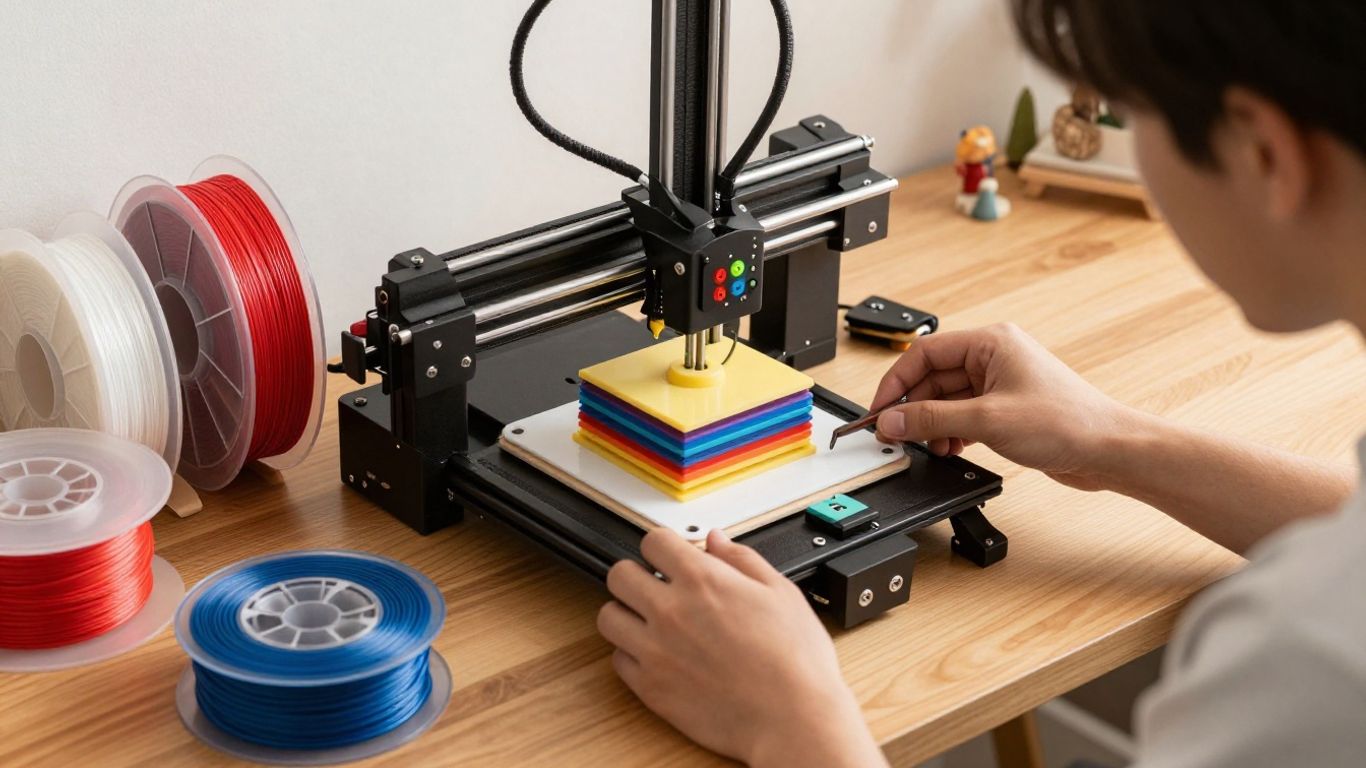
What 3D printer filament is and how it works
Filament is the long plastic strand that feeds into an FDM or FFF 3D printer. The printer softens it with heat, pushes it through a nozzle, and lays down many thin lines to build an object one layer at a time. When you see filament types explained, the useful question is not simply which one is strongest, but which material suits your printer and the job.
How filament becomes a finished 3D print
Your slicer turns a 3D model into movement instructions for the printer. The extruder grips the filament, the hot end melts a small amount, and the nozzle places it along each planned path. As each layer cools, it supports the next one until the part is complete.
The result depends on more than the plastic itself. Nozzle size, layer height, print speed, cooling, and the shape of the model all affect the finish. A material that works beautifully for a small bracket may need different settings for a tall, thin vase.
Why diameter, moisture, and storage matter
Filament must have a reasonably consistent diameter so the printer can push a predictable amount through the nozzle. If the strand varies too much, you may see thin sections, over-extrusion, or rough surfaces. Moisture can also enter the plastic, particularly in materials that absorb it readily.
Keep unused spools in a sealed container with fresh desiccant. Do not leave a spool sitting beside the printer for weeks if the room is humid. Damp filament can produce popping sounds, wispy strings, uneven layers, and a duller surface.
Understanding temperature and printer compatibility
Every spool should come with a suggested nozzle temperature range, and that range is a starting point rather than a guarantee. Your printer, nozzle, cooling fan, room temperature, and layer height can all shift the best setting. Check whether your machine has the required heated bed, enclosure, extruder path, and maximum hot-end temperature before buying a material.
A printer that handles PLA may not be ready for high-temperature or abrasive blends. Compatibility also includes the build surface: some plastics adhere readily, while others need careful bed preparation and a controlled environment.
The difference between standard and specialty filament
Standard PLA, PETG, and ABS are made for fairly predictable everyday printing. Specialty filaments modify the base plastic with flexible compounds, pigments, wood particles, mineral effects, or reinforcing fibres. Those additions can improve appearance or performance, but they may also make printing slower or more demanding.
Treat the label as a starting point. Read the manufacturer’s temperature guidance, check the nozzle requirements, and consider whether the extra feature solves a real problem for your part.
PLA: The easiest filament for most beginners
PLA is usually the first material you try because it prints at relatively low temperatures and tends to warp less than many alternatives. It is widely available in many colours and finishes, so you can learn the basics without fighting the material at every step. For household prototypes and decorative objects, it is often the sensible first choice.
Why PLA is popular for everyday prints
PLA is forgiving enough for learning bed levelling, first-layer checks, supports, and retraction. It generally produces clean-looking surfaces without needing an enclosure. That makes it useful for organisers, simple brackets, models, labels, and test pieces that will live indoors.
It also cools fairly readily, which helps small features keep their shape. You still need suitable settings, but PLA often gives you a clear result when you are diagnosing a printer rather than a difficult material.
PLA’s strengths for detail, color, and ease of use
Fine lettering, small decorative features, and colourful display pieces are natural PLA projects. It is available in matte, glossy, silk-like, and filled versions, although each finish can print a little differently. PLA is easy to learn because the usual temperature and cooling adjustments are not as demanding as those for many engineering materials.
A smooth first layer and a clean nozzle matter more than chasing a perfect profile. Start with the spool’s recommended range, print a small test, and adjust one setting at a time.
Where PLA falls short in heat and impact resistance
PLA is not the best choice for an item that will sit in a hot car, near a heater, or under sustained mechanical stress. It can become softer with heat and may crack rather than flex when hit or repeatedly bent. The exact behaviour varies between formulations, so treat a generic label as a broad guide rather than a performance guarantee.
For a household fix, ask what failure would look like. If the part only needs to hold its shape indoors, PLA may be enough. If it must tolerate warmth, impact, or repeated movement, consider PETG or a flexible material.
Best projects and print settings for PLA
PLA suits decorative models, fit-check prototypes, cable guides, drawer organisers, and light-duty household parts. Begin with the maker’s suggested nozzle and bed temperatures, moderate speed, and enough cooling for the shape. A brim can help a tall or narrow object stay attached, even though PLA normally has modest warping.
The best setting is the one that gives you a reliable first layer and clean walls on your own printer. Run a small temperature or bridging test before committing a full spool to a complicated part.
PETG: A strong step up from PLA
PETG sits between easy-printing PLA and more demanding high-temperature materials for many hobbyists. It is often tougher and less brittle than PLA, while remaining more approachable than ABS. You may need to accept a little more stringing and tuning in exchange for better performance in practical parts.
How PETG balances strength and flexibility
PETG can flex slightly instead of snapping immediately, which is helpful for clips, covers, brackets, and parts that receive ordinary knocks. It also tends to bond its layers well when printed at an appropriate temperature. That does not make every PETG part indestructible; wall thickness, print direction, and infill still matter.
Think of it as a useful middle ground. You gain durability for functional jobs, but you still need to manage bed adhesion, cooling, and stringing more carefully than with a basic PLA print.
When to choose PETG for functional parts
PETG is a practical option when a part needs more toughness than a decorative PLA object but does not justify an enclosed, high-temperature setup. It can work well for workshop organisers, protective covers, brackets, handles, and fixtures used indoors. Before using it for a critical part, test the actual shape and load rather than relying only on the material name.
The print’s geometry may be more important than the spool. Rounded corners, sensible wall thickness, and layers oriented along the stress can make a noticeable difference.
Common PETG issues such as stringing and poor adhesion
PETG can leave fine threads between separated features, especially when retraction, travel temperature, or moisture is not well controlled. It may also grip some build surfaces too aggressively or fail to stick if the bed is dirty or too cool. A clean surface and a small calibration print are safer than immediately changing several settings.
If stringing appears, try a modest temperature adjustment and review retraction and travel settings. If the first layer is poor, check bed cleanliness, levelling, and the recommended surface temperature before blaming the filament.
PETG settings and storage tips
Use the temperature range printed on the spool, then make small changes based on the surface and layer bonding you see. PETG benefits from a dry storage routine, particularly if the spool has been exposed to humid air. Keep it sealed between prints and dry it according to the filament maker’s instructions when symptoms suggest moisture.
Avoid placing the nozzle too close to the bed, since PETG can smear or bond too firmly when it has nowhere to spread. A little experimentation is normal, but record what works so the next spool is easier.
ABS, ASA, and other high-temperature filaments
ABS and ASA can handle jobs that are a poor fit for basic PLA, but they ask more of both you and the printer. They are more prone to warping and layer separation when temperature changes across the part. The extra effort makes sense when heat, impact, or outdoor exposure matters more than simple setup.
How ABS compares with PLA and PETG
ABS is generally tougher and more heat-tolerant than PLA, but it is less forgiving during printing. Compared with PETG, it often demands more control over drafts and ambient temperature. You may also need to consider fumes and ventilation, along with the printer’s enclosure and hot-end limits.
Use it because the part needs its properties, not because a higher temperature automatically means a better print. For many indoor household objects, PLA or PETG is easier and entirely adequate.
Why ASA works well for outdoor applications
ASA is commonly chosen for parts exposed to sunlight and changing weather because it is intended for outdoor use. It still needs careful temperature control and may warp, so the material does not remove the need for a suitable printer setup. Check the specific spool guidance before assuming it will perform the same way as another ASA blend.
It can suit outdoor brackets, covers, mounts, and enclosures when the design and installation are appropriate. Prototype the part first, especially if replacement would be difficult.
Ventilation, enclosure, and warping requirements
A stable enclosure helps reduce drafts and temperature swings around ABS and ASA prints. Ventilation is also important, and you should follow the printer and filament maker’s safety guidance rather than printing in a poorly ventilated room. A heated bed, suitable build surface, and a carefully prepared first layer are usually part of the setup.
Large flat footprints are particularly vulnerable to corners lifting. A brim, rounded corners, and a warm, consistent environment can help, but they cannot compensate for an unsuitable printer or incorrect temperatures.
When the added effort is worth it
Choose these materials when the finished part genuinely needs greater heat tolerance, impact resistance, or outdoor suitability. They can be worthwhile for workshop components, protective housings, and outdoor fixtures. For a small indoor organiser, the more complex setup may only create extra opportunities for failure.
Ask what the part will experience over its lifetime. That simple question usually narrows the material choice faster than comparing every technical property on a spool label.
Flexible and specialty filament types
Specialty filaments can change how a print looks, feels, or behaves. Flexible materials bend, filled materials add texture, and reinforced materials can increase stiffness. They are useful, but they also expose weaknesses in the printer, so start with a small object before attempting a large or intricate design.
TPU and other flexible materials
TPU and similar flexible filaments are useful for feet, gaskets, protective bumpers, cable straps, and parts that need to bend. They generally print more reliably at slower speeds with a carefully supported filament path. Long, loose routes through the extruder can make soft filament buckle or feed inconsistently.
A flexible part may need a different design as well as different settings. More walls can change its feel, while infill and layer direction affect how it bends.
Wood, marble, silk, and glow-in-the-dark blends
These blends are mainly chosen for visual character. Wood-filled filament can create a fibrous appearance, marble effects can disguise layer lines, silk blends can give a reflective surface, and glow additives can make a model stand out in low light. Results vary with temperature, layer height, and the amount of added material.
Filled blends can be less forgiving than plain filament. Keep the design simple at first and follow the spool’s guidance for nozzle size and temperature.
Carbon fiber and glass fiber reinforced filaments
Short carbon or glass fibres can make a printed part stiffer, but they do not turn a hobby print into an indestructible component. The fibres may also affect layer bonding, surface texture, and nozzle wear. Consider the loads, print orientation, and the base polymer rather than judging the material by the fibre name alone.
These filaments are most useful when stiffness matters and you have a printer that can handle the added demands. A test part is worthwhile before making a final tool or bracket.
Abrasive materials and compatible printer hardware
Some fibre-filled, glow, and mineral-filled materials are abrasive enough to wear a standard brass nozzle. A hardened nozzle may be more suitable, provided the printer can use it and the rest of the setup is compatible. Check the manufacturer’s requirements before feeding an unfamiliar blend through the machine.
The change is not only about the nozzle. Abrasive filament can also alter flow and require different retraction or temperature settings, so recalibration is sensible after changing materials.
How to choose the right filament for your project
Start with the part’s job, not the most impressive-looking spool. A decorative model, a flexible foot, and a sun-exposed bracket have different requirements even if they are printed on the same machine. Once you identify the likely stresses, the list of sensible materials becomes much shorter.
Matching material properties to the part’s purpose
Think about whether the object must bend, hold weight, survive knocks, tolerate heat, or simply look good. Also consider how it will be attached and whether the force will run across or along the printed layers. A material choice cannot rescue a design that has very thin walls or a weak orientation.
For a household repair, sketch the failure you want to avoid. That might be cracking, sagging, slipping, UV damage, or a part that is too stiff to clip into place.
Considering strength, flexibility, heat, and weather resistance
Strength is only one part of the decision. Flexibility can prevent brittle breakage, heat resistance can stop deformation, and weather resistance can matter more than either for an outdoor item. The table below gives a broad starting point, not a substitute for the manufacturer’s data or your own test print.
| Filament type | Typical reason to consider it | Main compromise |
|---|---|---|
| PLA | Easy indoor prints and detailed models | Lower heat and impact resistance |
| PETG | Tougher functional parts with some flexibility | More stringing and tuning |
| ABS | Heat and impact demands | Warping, ventilation, and enclosure needs |
| ASA | Outdoor exposure and weather resistance | More demanding temperature control |
| TPU | Flexible or soft-touch parts | Slower printing and feeding challenges |
Use the table to narrow your options, then check the actual spool instructions. Different blends sold under the same family name can behave differently.
Balancing print quality, cost, and difficulty
A cheaper spool is not necessarily cheaper if failed prints consume your time and plastic. Likewise, a premium specialty material may solve no real problem for a simple indoor part. Your printer experience, available tools, and tolerance for calibration should be part of the calculation.
A sensible approach is to keep one dependable everyday material available and add specialty filaments as specific needs arise. That way, experimentation does not interrupt every practical print.
Picking filament for prototypes, tools, and decorative models
PLA is a comfortable starting point for visual prototypes and decorative models. PETG is often more suitable for household tools and parts that receive regular handling. Flexible, reinforced, ABS, or ASA materials become more attractive when the part has a specialised requirement.
Before printing the final version, make a small test with the same orientation and a similar wall thickness. The test can reveal fit, flexibility, and surface problems while changes are still cheap.
Printing, storing, and troubleshooting filament
Good filament cannot compensate for a dirty bed, a worn nozzle, or a poorly calibrated first layer. Treat the material, printer, and environment as one system. Small notes about successful settings can save you from repeating the same troubleshooting session months later.
Recommended nozzle and bed temperatures
The recommended range on the spool is the best starting point because formulations differ. Choose a middle value, print a small test, and adjust gradually if the layers are weak, the surface is rough, or the material strings. Bed temperature affects adhesion and warping, so use the spool guidance alongside your build surface instructions.
Avoid copying a setting from another material simply because the names sound similar. Even two colours from one family can behave a little differently.
Preventing moisture-related print problems
Store opened filament in an airtight container with desiccant and limit how long it sits exposed to room air. If you hear tiny pops from the nozzle or see inconsistent extrusion and excessive stringing, moisture is one possible cause. Dry the spool only with a method and temperature recommended for that material.
The safest routine is preventative. Label opened spools, keep storage tidy, and avoid assuming that a spool is dry just because its outside looks fine.
Fixing warping, stringing, layer separation, and clogs
Troubleshooting is easier when you change one variable at a time. Check the first layer and filament path before making complicated slicer changes. These common symptoms usually suggest starting points:
- Warping: check bed preparation, bed temperature, drafts, and the part’s footprint.
- Stringing: review temperature, retraction, travel moves, and filament dryness.
- Layer separation: check nozzle temperature, cooling, print speed, and drafts.
- Clogs: inspect the nozzle, filament path, heat break, and material for contamination.
After each adjustment, print a small test that isolates the problem. A result you can compare is more useful than changing five settings at once.
Knowing when to dry, replace, or change filament settings
Dry the spool when moisture symptoms are plausible and the material can be safely dried according to its instructions. Replace or discard it when contamination, severe tangling, or repeated damage makes feeding unreliable. Change slicer settings when the material is sound but the printer is producing predictable defects.
Keep a short record of the spool, nozzle, temperatures, and useful adjustments. Over time, that record becomes more valuable than a generic profile because it reflects your particular printer and environment.
Conclusion
Choosing filament becomes much simpler when you match the material to the part’s real job. Start with PLA for easy indoor learning, move to PETG when you need tougher functional prints, and reserve flexible, reinforced, ABS, or ASA materials for clearly defined requirements. Store every spool carefully, test small, and let the printer’s behaviour guide your final adjustments.
Frequently Asked Questions
What is the easiest filament for a beginner?
PLA is usually the easiest place to start because it prints at relatively low temperatures, is widely available, and tends to warp less than many other materials.
Is PETG stronger than PLA?
PETG is often tougher and less brittle than PLA, but the final strength depends on the formulation, print settings, design, and layer orientation.
Can you use any filament in any 3D printer?
No. Check the printer’s temperature limits, nozzle, extruder path, build surface, enclosure requirements, and the filament maker’s instructions before printing.
Why does filament become stringy?
Stringing can result from excessive temperature, unsuitable retraction, travel settings, slow travel moves, or moisture in the filament.
How should you store 3D printer filament?
Keep opened spools in an airtight container with desiccant, away from humid air, and dry them only according to the material’s instructions when needed.
Is ABS suitable for outdoor parts?
ABS can suit some demanding parts, but it needs careful temperature control and is not automatically the best outdoor choice. Consider a material intended for outdoor exposure when weather resistance matters.
When should you use flexible filament?
Use flexible filament for parts such as bumpers, gaskets, feet, straps, and protective covers where bending or a soft feel is useful. Expect slower printing and more careful feeding than with rigid materials.